
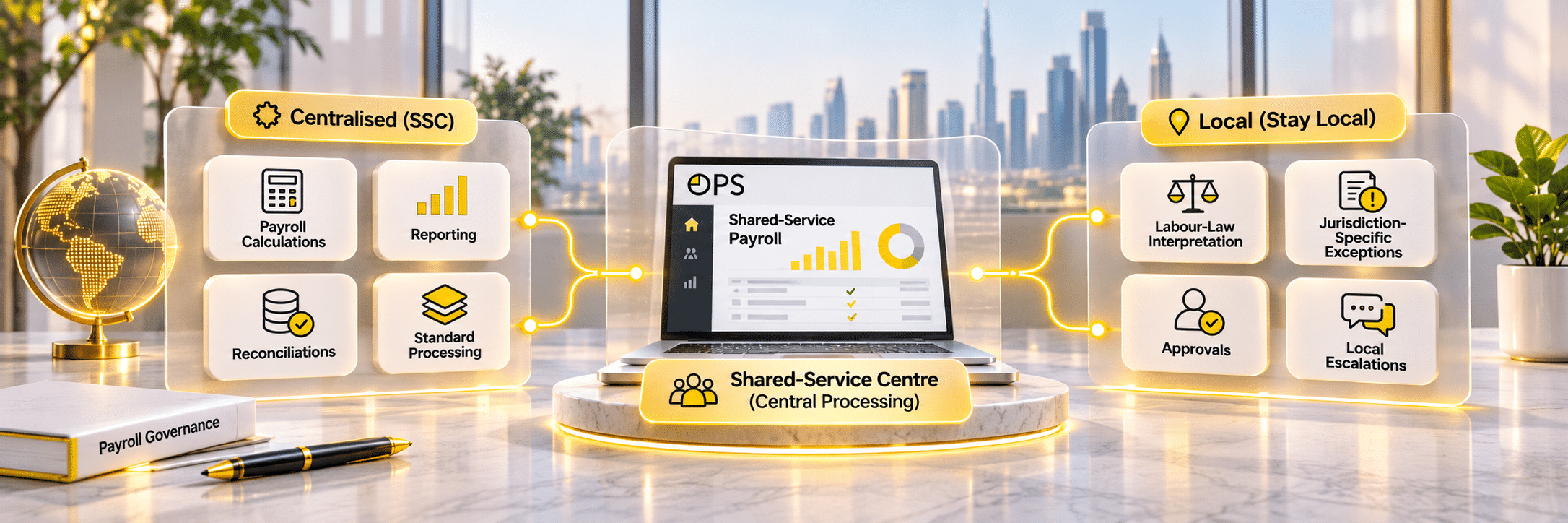
Which payroll activities should be centralised, and which should remain local?
Short answer: payroll shared-service centres can centralise payroll calculations, reporting, reconciliations, data validation and process controls. However, employment-law interpretation, jurisdiction-specific exceptions, statutory account authorisations and certain employer approval decisions need clear local ownership. The strongest model combines consistent central processing with named local accountability, documented exceptions and an approval trail for every payroll cycle.
A shared-service payroll model promises greater consistency, better cost visibility and fewer duplicated processes. For businesses operating across the Middle East, the benefits can be substantial.
But payroll is not simply an administrative function that can be moved from one office to another.
Each country has its own employment rules, wage payment requirements, statutory contributions and reporting obligations. A process that works for one entity may create problems for another.
The challenge for regional CFOs is deciding what can be managed centrally without losing the local knowledge and authority needed to make the right payroll decisions. That boundary is the central design problem in payroll shared-service centres.
1. Why payroll shared-service centres do not centralise every decision
A regional shared-service centre may process payroll for employees in the UAE, Saudi Arabia, Qatar, Bahrain and other markets.
While the monthly process may look similar, the underlying requirements are not identical.
For example, UAE employers covered by the relevant Ministry of Human Resources and Emiratisation rules must meet applicable Wage Protection System (WPS) requirements [1]. Saudi employers have their own wage protection, social insurance and employment administration obligations [3].
Compliance check required: The specific scope, thresholds and submission mechanics of wage protection in each GCC market should be verified against current official guidance for the relevant entity before an operating model is fixed. This article does not state country-specific deadlines, thresholds or penalties.
A shared-service team can prepare data and manage standard processes, but it should not assume one country’s requirements apply to every employee.
The distinction is between processing responsibility and decision-making authority.
Central teams can manage repeatable tasks. Local owners should remain accountable for decisions requiring jurisdiction-specific interpretation, employer authorisation or knowledge of local employment arrangements. The same principle sits behind a documented payroll responsibility matrix: processing can move, accountability has to be named.
That distinction needs to be written into the operating model, not left to individual judgement during payroll week.
2. Three operating models for regional payroll
Businesses generally have three options when organising payroll across several countries. The choice decides how payroll shared-service centres allocate authority, not only workload. Each carries a different balance of consistency, local expertise and control risk.
Fully local payroll
Each country manages its own payroll inputs, calculations, approvals and reporting. This supports local knowledge but can create duplicated work, inconsistent controls and limited regional visibility.
Fully centralised payroll
A single team manages most activities across all countries. This can improve reporting consistency and process standardisation. However, it creates risk when central teams lack local expertise or cannot obtain timely statutory and employer approvals.
Hybrid shared-service payroll
The central team manages standard processing, reconciliations, reporting and quality checks. Local representatives retain ownership of country-specific decisions, exceptions and required authorisations.
For many regional organisations, this offers a more practical balance. The central function operates a common payroll process, while each entity maintains the controls needed for its jurisdiction.
The objective is not to keep more work local. It is to keep the right decisions local.
Comparing the three models
| Model | Main advantage | Main control risk | Best suited to |
|---|---|---|---|
| Fully local payroll | Local expertise sits with the people doing the work | Duplicated effort, inconsistent controls, limited regional visibility | Few entities, or markets with highly divergent requirements |
| Fully centralised payroll | Consistent reporting and standardised process | Central team may lack local expertise or timely statutory and employer approvals | Single-country groups, or highly similar jurisdictions |
| Hybrid shared-service payroll | Common process with local decision ownership retained | Boundaries blur unless exceptions, approvals and escalations are documented | Multi-country GCC groups with several legal entities |
For payroll shared-service centres, this comparison is an operating-model summary, not a legal classification. The right model depends on entity structure, system permissions and the approvals each jurisdiction requires.
3. Which payroll activities should stay central or local?
The following allocation is a recommended operating approach for payroll shared-service centres, not a universal legal requirement.
| Payroll activity | Recommended ownership |
|---|---|
| Payroll calendar management | Central team, validated locally |
| Employee master data checks | Central team with local HR confirmation |
| Gross-to-net calculations | Central team |
| Monthly payroll reconciliation | Central finance/payroll |
| Employment-law interpretation | Local qualified specialist or adviser |
| Country-specific statutory exceptions | Local owner with central processing support |
| Statutory payroll configuration | Central specialist, subject to local verification |
| Final payroll approval | Authorised employer representative |
| Bank and statutory file preparation | Central team, where permitted |
| Payment execution and statutory submissions | Authorised party under local rules |
| Consolidated payroll reporting | Central finance |
| Payroll audit evidence | Central repository with entity-level ownership |
In payroll shared-service centres, centralisation should reduce duplicated processing without making accountability less visible.
For example, a central team may calculate an employee’s final settlement. The applicable employment rules and the underlying employment facts must still be confirmed for the relevant entity before the settlement is approved.
The same principle applies to employee deductions, allowances and statutory contributions.
4. Build a jurisdictional exception register
A common challenge in payroll shared-service centres is handling situations that do not follow the standard monthly process.
Consider an employee moving between two group entities, a disputed deduction or a change in the treatment of an allowance.
If the central team relies on informal emails to resolve these cases, the decision may be difficult to explain later. The same exposure appears when payroll change requests after cut-off are handled outside a controlled route.
A jurisdictional exception register provides a structured record.
At minimum, the register should capture:
- Country and legal entity: Identify the employer and applicable jurisdiction.
- Exception type: Record the issue, such as a settlement, deduction or statutory treatment.
- Rule or policy reference: Link to the relevant official source, approved policy or documented advice.
- Local decision owner: Name the person authorised to determine the treatment.
- Processing instruction: State what the central payroll team must do.
- Approval and effective date: Record when the decision was authorised and which payroll cycle it affects.
- Review status: Confirm whether the exception is temporary, recurring or closed.
For example, if an allowance is treated differently across two entities, the register should document why the difference exists and who verified it. This prevents a local exception from becoming an undocumented rule in the central payroll system, which is how payroll shared-service centres quietly accumulate treatments nobody can explain. The distinction matters most where free zone versus mainland payroll arrangements sit inside the same group.
5. Give every local escalation a named owner
In payroll shared-service centres, central teams need to know who can answer a question before a payroll deadline becomes urgent.
A shared mailbox or general escalation group is not enough when a decision requires local authority. Concentrating that authority in one undocumented individual creates payroll key-person risk.
Each country should have a named primary contact and a backup, with clear approval limits.
An effective escalation process should answer four questions:
- Who identifies and records the issue?
- Who has the authority to decide the correct treatment?
- How quickly must the decision be returned?
- What happens if the primary decision-maker is unavailable?
Worked example: a late termination adjustment
Consider a late termination adjustment received after payroll has been calculated.
Step 1: The central team identifies the scope
The central team should identify the affected employee, entity and payroll version.
Step 2: The local owner confirms the treatment
Local HR or another authorised specialist then confirms the relevant facts and treatment.
Step 3: The payroll returns for approval
The central team recalculates the affected figures and performs the required checks. If the approved payroll changes, the revised version must return for approval before payment release. A documented payroll sign-off gate is what makes that re-approval provable afterwards.
That approach protects both processing accuracy and decision accountability.
What OPS sees in practice
The following is an operational observation drawn from how payroll shared-service centres typically break down. It is not client data or a statistical finding.
| Area | Common issue | Operational risk | Control |
|---|---|---|---|
| Exception handling | Country-specific decisions agreed over email | Treatment cannot be explained or reproduced later | Jurisdictional exception register with a named decision owner |
| Escalation | Queries routed to a shared mailbox | Decisions arrive after the calculation is locked | Named primary and backup contact per country, with response times |
| Approval | Re-approval skipped after a post-sign-off change | The released payroll is not the approved payroll | Version-controlled sign-off before every payment release |
| Configuration | One entity’s set-up copied to a new country | Statutory treatment applied where it does not belong | Local verification sign-off before a new entity goes live |
| Evidence | Approvals held in individual inboxes | Prior cycles cannot be reconstructed on request | Central evidence repository with entity-level ownership |
6. Protect employee data when payroll crosses borders
Payroll shared-service centres often involve moving sensitive employee information between local entities, regional teams and external providers.
Salary records, bank details, identification numbers and employment documents require controlled access.
Regional organisations should establish clear rules for:
- Role-based access to employee information.
- Secure transmission between entities and processing teams.
- Independent verification of bank-detail changes.
- Controlled approval of employee data changes.
- Documented retention and deletion arrangements.
- Access reviews when employees change roles or leave.
Cross-border data transfers also require legal assessment under the data protection rules applicable to the organisations and information involved.
Compliance check required: Cross-border transfer conditions differ by jurisdiction and by the data protection regime that applies to each entity. The applicable transfer basis should be confirmed with qualified local advice before employee data moves between countries or to an external processor.
A central team should not assume that access permitted in one jurisdiction automatically permits unrestricted processing or transfer elsewhere.
The goal is to make information available to authorised payroll users without giving every participant access to the full regional workforce record.
7. Use a RACI matrix to clarify payroll accountability
A RACI matrix identifies who is Responsible, Accountable, Consulted and Informed for each activity. The following example shows a possible hybrid shared-service model and is a governance starting point for payroll shared-service centres, not a finished allocation.
| Activity | Responsible | Accountable | Consulted / Informed |
|---|---|---|---|
| Submit employee changes | Local HR | Local HR lead | Central payroll |
| Validate payroll inputs | Central payroll | Central payroll lead | Local HR |
| Confirm local statutory treatment | Local specialist | Authorised entity owner | Central payroll |
| Process payroll calculations | Central payroll | Central payroll lead | Local HR |
| Review payroll variances | Central payroll reviewer | Central payroll lead | Local finance |
| Approve final payroll | Authorised employer approver | Employer finance authority | Central payroll |
| Prepare payment files | Central payroll | Central payroll lead | Treasury |
| Authorise payment release | Authorised payment team | Employer finance authority | Central payroll |
| Maintain payroll evidence | Central payroll | Entity records owner | Finance and audit |
Illustrative RACI only. Actual roles depend on entity structure, jurisdiction, system permissions and the agreed service scope. Accountability here refers to the internal operating model; it does not transfer statutory employer obligations.
The matrix should be reviewed whenever an organisation adds a new country, changes a payroll provider or restructures its finance function. A useful test is whether each activity has exactly one clearly identified operationally accountable owner.
8. How CFOs can test whether the model is working
Payroll shared-service centres should be measured by more than the number of payrolls processed. Regional finance leaders should examine the controls that protect accuracy, timing and accountability. Five measures provide a useful starting point.
- First-pass payroll accuracy: How many payroll runs require correction after the initial calculation?
- Exception resolution: How many country-specific issues remain unresolved at the agreed cut-off?
- Approval timeliness: Are employer approvals completed before the relevant payment and banking deadlines?
- Reconciliation quality: Can Finance explain material movements in gross pay, deductions, net pay and employer costs?
- Evidence availability: Can the team retrieve the approved payroll version, exception decisions and payment confirmations for a previous cycle?
These measures help identify whether payroll shared-service centres have genuinely improved control or simply moved operational problems into a different team. Reading them alongside payroll funding forecasts gives Finance both the control view and the cash view of the same cycle.
9. How OPS supports a governed regional payroll model
At OPS, regional payroll delivery for payroll shared-service centres is built around clear ownership, country-specific requirements and a controlled monthly payroll cycle.
As a long-standing specialist in GCC payroll, OPS supports organisations that need consistent payroll operations without losing the local expertise required for individual markets.
Our approach includes defined payroll calendars, input validation, statutory checks within the agreed scope, independent quality assurance, variance review and employer sign-off before release. These are the same controls that sit behind OPS managed payroll delivery.
Each payroll account has named specialist ownership, supported by documented processes and escalation arrangements.
For businesses reviewing a shared-service model, OPS can help assess where processing can be consolidated, where local expertise remains necessary and how responsibilities should be documented. The same review discipline applies when payroll moves between entities during an acquisition due diligence exercise.
The value of a regional payroll model is not simply processing more payrolls from one location. It is giving leadership a clearer, more accountable process across the markets they operate in.
10. Frequently Asked Questions
Can all GCC payroll activities be centralised?
Many administrative and processing activities can be centralised. However, certain statutory authorisations, employer decisions and jurisdiction-specific interpretations require local ownership or verification. The correct allocation depends on the country, entity and operating model.
Who is responsible for payroll compliance in a shared-service centre?
The employer retains obligations placed on it by applicable law. A shared-service team or payroll provider may perform agreed processing and compliance checks, but that arrangement does not automatically transfer statutory responsibility.
What is a jurisdictional exception register?
It is a documented record of payroll cases requiring country-specific treatment. It identifies the issue, applicable rule, local decision owner, approval and instructions for payroll processing.
What is the biggest risk in centralised payroll?
One major risk is unclear decision ownership. When a central team processes a country-specific exception without verified local direction, an otherwise consistent process can produce an incorrect or unsupported outcome.
How does a RACI matrix improve shared-service payroll?
A RACI matrix clarifies who performs each activity, who is operationally accountable, who provides advice and who needs to be informed. It reduces approval gaps and makes payroll issues easier to investigate.
What is the difference between centralised payroll and payroll shared-service centres?
Centralised payroll describes where the processing happens. Payroll shared-service centres describe the operating structure that delivers it, including the governance, escalation and approval arrangements around the processing. A shared-service centre can run a hybrid model in which processing is central but defined decisions remain with local owners.
Conclusion: Centralise processing, not accountability
Successful payroll shared-service centres depend on more than common systems and centralised teams.
It requires clear boundaries between standard processing and local decisions. Payroll shared-service centres depend on documented exceptions, authorised approvers and a reliable monthly evidence trail.
For CFOs and shared-service leaders, the priority should be to establish a model that improves efficiency without weakening payroll governance. Payroll problems have a habit of becoming urgent on exactly the wrong day: salary day.
When local accountability and central processing work together, organisations gain greater visibility, consistency and control over their regional payroll operations.
Review your shared-service payroll operating model with OPSAre you reviewing which payroll activities to centralise and where local expertise should remain? OPS can help you assess payroll responsibilities, exception handling, approval controls and regional processing requirements. Speak with OPS about where processing can be consolidated, where local expertise has to stay, and how those responsibilities should be documented. |
Sources
Official sources
- [1] UAE Government, Payment of Salaries and Wages: u.ae
- [2] UAE Ministry of Human Resources and Emiratisation: mohre.gov.ae
- [3] Saudi Ministry of Human Resources and Social Development: hrsd.gov.sa
Related OPS reading
- Payroll Outsourcing Responsibilities: Who Owns the Payroll Error?
- Payroll Sign-Off Gate: What a Documented Approval Has to Prove
- Payroll Key-Person Risk: What Happens When the Only Person Who Knows Your Payroll Leaves
Compliance note: This article provides operational guidance, not legal or tax advice. Local employment, data protection, wage payment and statutory filing requirements should be checked against current official sources and qualified local advice before implementation. OPS payroll assurance and audit-readiness refer to operating controls within an agreed service scope, not a regulatory guarantee.