
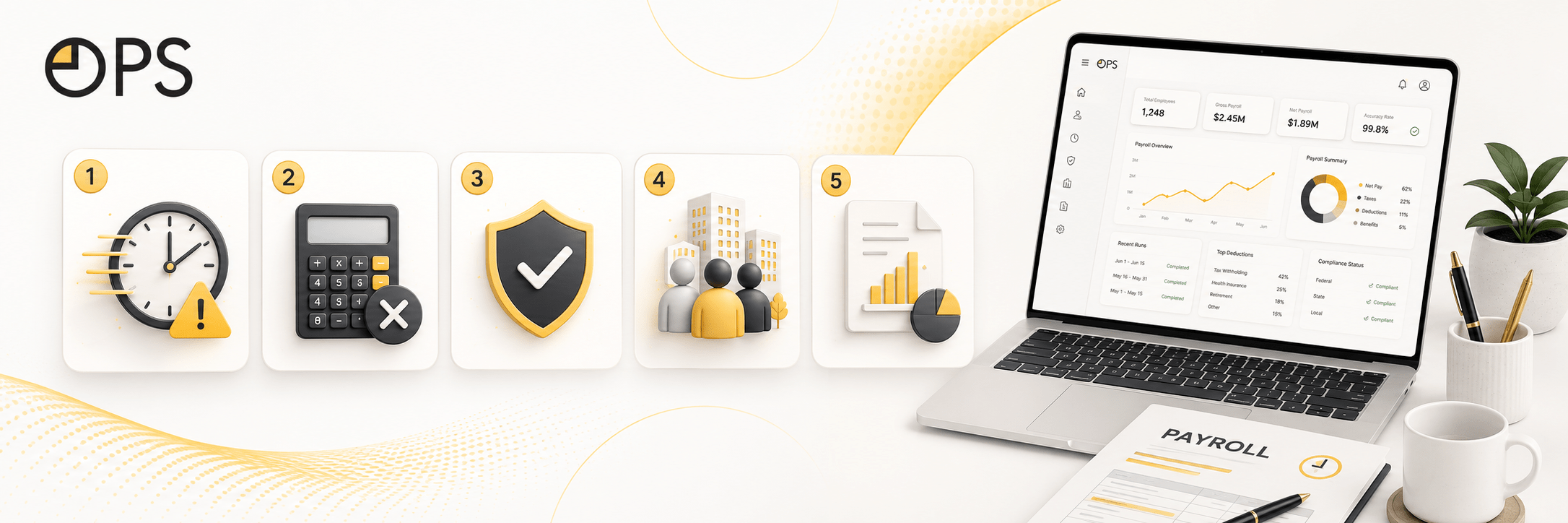
The clearest signs it’s time to outsource your payroll rarely arrive all at once. Payroll erodes: one manual workaround, one missed deadline, one “we’ll fix it next cycle” at a time. If you’re an HR or payroll specialist, you may already recognise one of these signs: a single person holding the whole cycle in their head, a compliance detail (WPS, gratuity, leave pay) that keeps resurfacing, or a spreadsheet count that’s grown quietly out of control. OPS’s payroll, compliance and client-facing teams see the same five signs again and again before a company decides to outsource payroll. Here they are.
1. Your payroll depends on one person
Ask what happens to next month’s payroll if your payroll lead is unreachable for two weeks. If the honest answer is “we’re not sure,” that’s the first sign.
“Companies are concerned that their current payroll process is too dependent on one person and does not have sufficient checks and balances,” says Diana Kotze, OPS leadership.
It’s a pattern Venus Agoncillo, OPS’s Customer Success, Service Delivery & Compliance Lead, sees constantly in smaller UAE setups, where HR and finance collapse into a single role: “That person may be very capable… however, that kind of process is not resilient. They know the deadlines, they know the exceptions, they have manual workarounds. However, if they are unavailable, if they leave the business, if they are overloaded, the company is suddenly crippled.”
Camille Anchoriz, an OPS payroll specialist, has seen the same failure operationally: a key payroll person left without a proper handover, and “important payroll tasks, statutory deadlines, and client-specific requirements were known only to that individual, resulting in delays and compliance risks.” Christopher Naidoo, OPS’s Regional Operations Manager, calls this a single point of failure. Outsourced payroll teams are built with a backup by design: “there’s always a second person that’s able to step in.”
2. Manual workarounds are multiplying faster than your headcount
Spreadsheets and manual checks work fine when a company is small. The tell that you’ve outgrown them isn’t a specific headcount; it’s the volume of manual steps required to get one payroll cycle over the line.
“It’s usually not one big issue, it’s a lot of small manual processes that have built up over time,” Camille says. “Those work when the company is small, but as it grows, they become harder to manage and more prone to errors. The biggest sign is when manual work keeps increasing.”
Headcount itself is a poor predictor, Christopher notes: a 111,000-person mining payroll he once ran was simpler than payrolls a fraction of the size. “A company with 20,000 people is far easier to run than a company with 100 people, because of the complexity within the payroll.” What drives the workload is complexity: multiple entities, mixed pay structures (commission tiers, shift allowances, overtime), and employee populations that combine contract types, such as MOHRE-registered and non-MOHRE-registered staff in the same system, each handled differently.
3. Compliance details keep catching you off guard
For most employers, the pain point that finally brings them to a provider is compliance, not cost.
“Employers are usually looking to stay compliant and ensure certain controls are in place,” Diana explains. “Often, something has already gone wrong: an incorrect gratuity calculation, a WPS submission that’s been rejected, or payroll that’s been delayed or blocked.”
Camille points to the same pressure point operationally: “Currently, WPS, as MOHRE has introduced several updates and is now enforcing compliance more strictly.”
This compounds once a company spans more than one entity or jurisdiction. Venus flags a distinction many in-house teams underestimate: employers in the UAE can have both MOHRE-registered and non-MOHRE-registered employees in the same workforce, and only one group is subject to WPS reporting. A DIFC entity may also need to administer the DIFC Employee Workplace Savings (DEWS) scheme, while a mainland or free-zone entity in the same group follows separate WPS rules. Add cross-border moves (a Qatari national working in the UAE, or a Saudi employee’s GOSI obligations) and the compliance surface expands well beyond what one generalist can track.
Compliance check required: specific WPS deadlines, gratuity formulas, DEWS contribution rules, and GOSI/GPSSA rates change periodically and should be confirmed against MOHRE, GPSSA, DIFC, and the relevant GCC social-insurance authority before being used in employee communications.
4. Small errors are becoming expensive because no one catches them early
The instinct is to measure a payroll mistake by the amount that was over- or underpaid. That’s the smallest part of the real cost.
“That amount is the smallest part,” Venus says, “because the larger cost is the time you have to spend to investigate, to correct, to communicate, to rebuild the trust. Payroll is personal: if an employee is paid incorrectly, they experience it as a breach of trust, not an admin error.”
Diana adds the compounding dimension: “An incorrect calculation of even AED 100 or 200 per employee may appear insignificant in one month. But if it becomes embedded in the process and repeats across employees and cycles, it has a multiplier effect. An isolated error that’s caught and corrected immediately has limited impact. The greater risk is one that becomes institutionalised.”
Camille’s advice to any business owner is the practical countermeasure: “Review your payroll process regularly rather than assuming everything is working. Even small errors in salaries, deductions, or statutory compliance can become costly if they’re not caught early.”
5. You have no real oversight, reporting, or audit trail
The last sign is structural: when something does go wrong, is there a defined process to catch it, escalate it, and prevent it from recurring, or does resolution depend on someone remembering to follow up?
Venus describes what changes once payroll moves to a structured outsourced model: defined report timelines, formal approval points before a report is issued, and exception tracking. “If you are managing it in-house, there are no trackers like that. If you remember to carry out an exception the following month, you’re lucky. If you don’t, you cause a payroll error.”
Diana Kotze puts it plainly: “The client doesn’t only receive payroll processing. They receive a controlled operating model with segregation of duties, quality assurance, escalation paths, compliance oversight, and management information.”
What OPS sees in practice
| Area | Common issue | Operational risk | Control that closes it |
|---|---|---|---|
| Key-person dependency | One person holds process knowledge | Payroll stalls if they’re unavailable | Documented handover + backup coverage |
| Manual inputs | Leave, overtime, exceptions tracked by memory or spreadsheet | Errors compound across cycles | Input deadlines, exception logs, pre-payroll review |
| Multi-entity compliance | MOHRE vs non-MOHRE, WPS vs DEWS, GCC social insurance | Filings missed or misapplied | Entity-level compliance mapping, specialist review |
| Reporting | Reports issued without sign-off | Errors reach payment before anyone checks | Defined approval points before release |
In-house vs outsourced: what actually changes
| Typical in-house setup | Outsourced (OPS model) | |
|---|---|---|
| Process knowledge | Concentrated in one or two people | Held by a team; documented and covered |
| Error detection | Relies on memory or manual review | Exception tracking and QA review built in |
| Compliance monitoring | Reactive, after an issue surfaces | Dedicated governance function |
| Reporting | Ad hoc, published without formal sign-off | Standardised, with defined approval points |
| Multi-jurisdiction coverage | Depends on individual expertise | Specialist coverage across entities and countries |
Is outsourcing actually cheaper?
Not always, and OPS doesn’t lead with cost as the reason to switch.
Christopher Naidoo puts it plainly: “To outsource a payroll actually costs more than to run it internally” on a like-for-like service-fee basis. Small payrolls are the exception, since building an internal function from scratch can cost more per employee.
The fairer comparison is total cost and risk: internal staff, systems, leave cover, training, and error correction, versus one accountable partner. For larger or multi-country operations, expertise is the harder constraint. Finding one person who covers payroll compliance across several jurisdictions, Christopher says, “is like a needle in the haystack.”
The bottom line
None of these signs it’s time to outsource payroll require a crisis to act on. As Camille puts it, the simplest check any business owner can run today is to stop assuming the payroll process is working and go verify it. If one or more of these signs sound familiar, a structured review is worth doing before the next payroll cycle, not after the next mistake.
Speak to OPS about a payroll compliance review. Visit ops.ae.